Make better investment decisions and get more return as complexity grows
For CEOs, founders, leaders and senior managers in Product, Technology, Digital, Innovation and Transformation who lead or contribute to significant decisions and initiatives across teams and functions.
The Leader Cohort is a 12-week application of the Decision Accelerator approach to a real decision, initiative or growth objective in your organization.You apply the work with individual guidance, AI Thinking Partner tools and weekly discussions with a small group of experienced peers.
You may see the direction. Getting the organization moving together takes more.
As organizations grow and transform, important investment, innovation and transformation decisions involve more people, perspectives and dependencies.Customer insight, operational knowledge and experience sit across different teams, while leaders naturally see the situation through their own responsibilities.You may already have a strong view of where the organization needs to go, yet creating enough confidence and commitment for people to move together takes too much of your time and energy.Decisions get revisited, priorities compete and progress depends on your continued involvement.Even when work is moving, you may question whether the organization is investing in the opportunities, products and solutions that could create the greatest value.The challenge is bringing relevant knowledge and perspectives into the decision, exercising judgment and establishing enough alignment for people to act.That does not require complete consensus or for you to carry the whole picture yourself.
The economic cost of decision friction
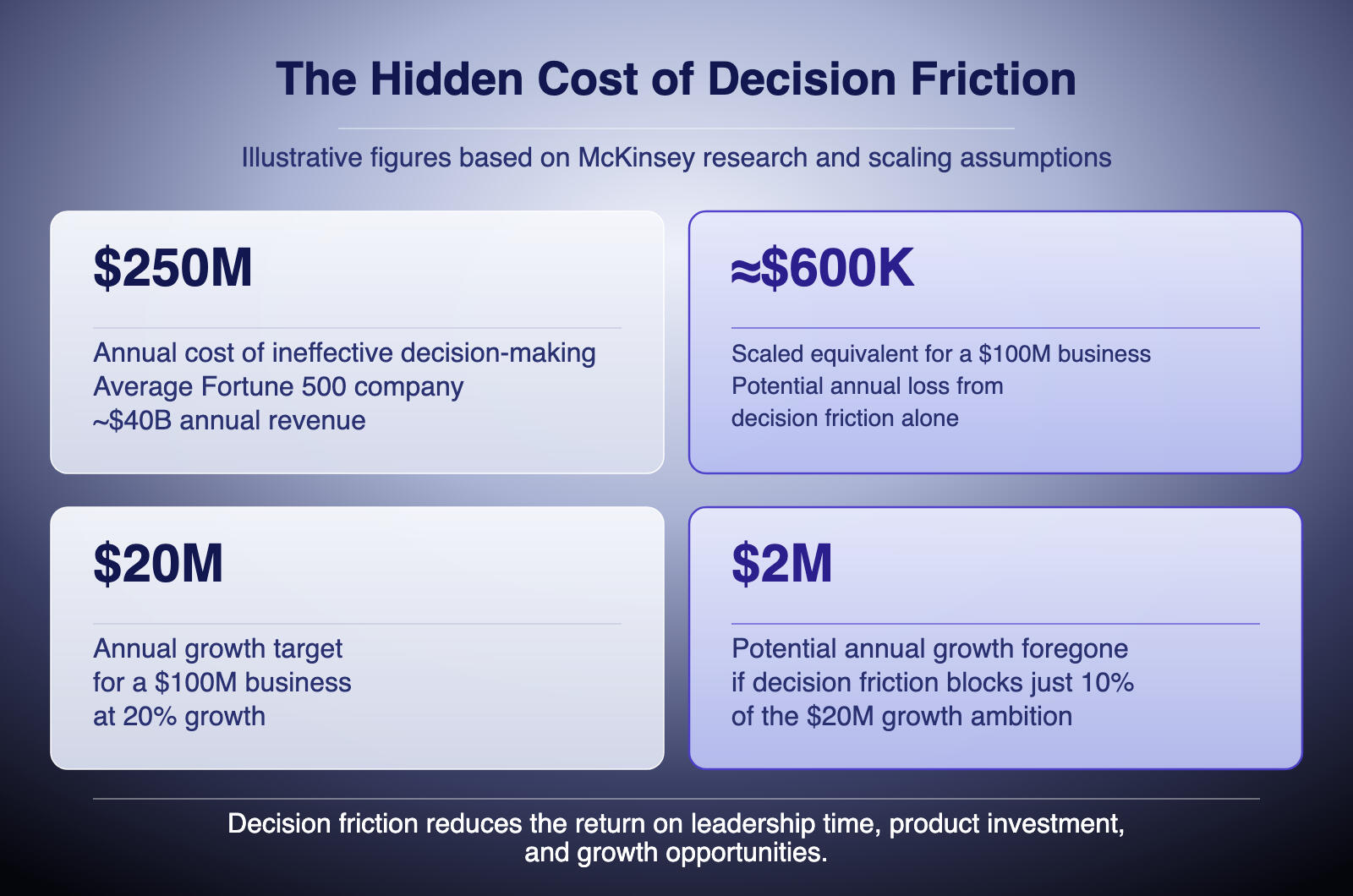
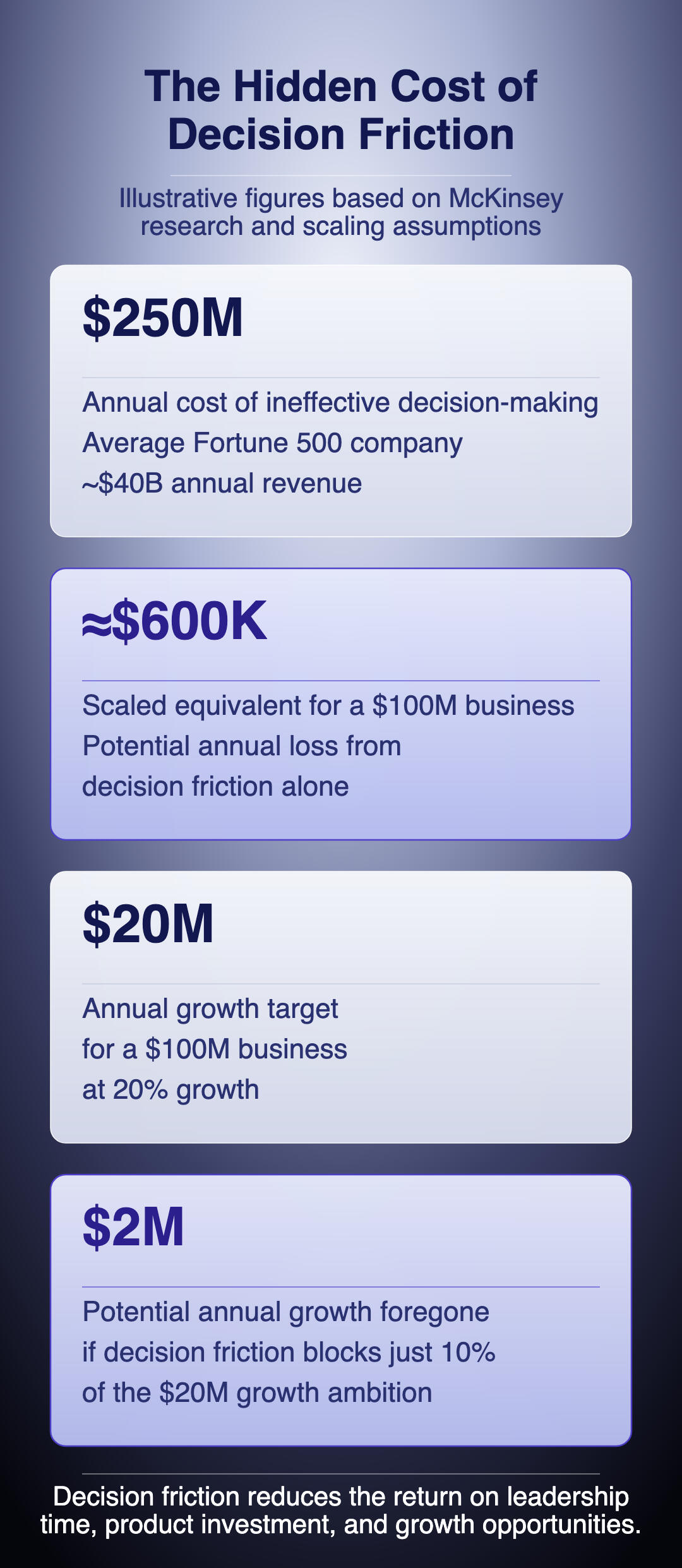
Decision friction consumes leadership capacity and affects the return on what the organization chooses to invest in.McKinsey research involving more than 1,200 business leaders found that 61% said at least half of the time spent making decisions in their organizations was ineffective.For a typical Fortune 500 company, McKinsey estimated around 530,000 days of managers’ time and roughly $250 million in wasted labor costs each year.The scale differs in smaller organizations, but time spent coordinating, reopening decisions and resolving the same questions still carries a cost.A further cost comes from investing in work that creates less customer and business value than it could.In a study of feature usage across 615 software products, Pendo found that 80% of features in the average product were rarely or never used, while an average of just 12% generated 80% of daily usage.Low usage does not automatically mean a feature is unnecessary or without value.It does, however, raise an important question about how development effort translates into customer value.As AI accelerates what organizations can build and deliver, the quality of the thinking behind those investments becomes even more consequential.
Apply the Decision Accelerator to work that matters in your organization
You begin with one real decision, initiative, growth objective or organizational learning question.It might be an approaching investment, an initiative that has stalled, a new opportunity or a need to understand what customer and organizational signals mean for your next priorities.Over 12 weeks, you apply the Decision Accelerator approach to that situation, with my guidance and the perspectives of other experienced leaders and managers.You bring relevant information and colleagues’ contributions into the work within your organization, while keeping confidential material private.Human thinking and AI work together throughout.People contribute experience, analytical thinking, intuition, imagination and judgment, while AI adds speed and scale to analysis and synthesis and helps reveal further patterns, connections and questions.The work follows four connected steps, returning to earlier questions when new information is needed.1. REALITYWhat do we know, and what have we not yet noticed?Bring together relevant customer insight, organizational information, observations and previous learning.Examine these alongside your own experience and colleagues’ perspectives to recognize patterns, challenge assumptions and explore possibilities.2. ALIGNWhat does this mean for our objective, and what needs to be decided?Develop sufficient understanding across the people involved, including where their perspectives differ and what remains unresolved.Clarify the decisions needed, how they depend on each other, who has authority to make them and what information is still missing.3. DECIDE & COMMITWhat can we decide, and what will it take to act?Develop and weigh options, considering benefits, uncertainties and consequences.Work with the relevant decision-makers to agree on focus, responsibilities, resources and next steps.4. EXECUTE & LEARNWhat happens when we put the decisions into practice?Follow progress against the intended benefit and examine the results and experience available during the cohort.Carry that learning into subsequent choices, so the next decision benefits from what has already been discovered.
Individual guidance, shared learning, private application
You work on your own organizational situation, with a direct working relationship with me throughout the 12 weeks.We have three individual session to examine your context in depth, discuss the decisions and questions arising, and adapt the work as it develops.Between sessions, you have a private Slack channel with me for questions, reflection and ongoing support.You work with information, observations and experience specific to your organization, using the AI environment you or your organization approve.You do not need to share that material with the cohort to benefit fully from the program.Alongside the individual work, we meet in a group of up to 10 participants for one 90-minute session each week, including discussion and Q&A.These sessions provide guidance through the Decision Accelerator approach and opportunities to examine questions, compare experiences and learn from other leaders.You can discuss how to approach a decision, involve colleagues or explore different interpretations without revealing the underlying company information.The group adds perspectives and peer learning, while our individual sessions provide space for the detail that belongs in a private conversation.Most of the application happens within your existing responsibilities, using decisions, information and conversations already relevant to your organization.You receive:
Three individual sessions with me, focused on your situation and the application of the work.
Weekly 90-minute group sessions with discussion and Q&A, throughout the 12-week program.
A private Slack channel for support between sessions.
Guidance through the Decision Accelerator workflow, including gathering perspectives, examining findings, preparing decisions and establishing commitments.
AI Thinking Partner instructions and tools, adapted to the approved AI environment you use.
You involve relevant colleagues within your organization where their knowledge, commitment or decision authority is needed.Direct competitors will not be placed in the same cohort.
What you work toward during the cohort
The immediate aim is to move your chosen situation forward while establishing a way of working you can continue to use.By the end of the cohort, you work toward:
A clearer basis for action, bringing relevant information, observations, possibilities and open questions together.
Better-prepared decisions, with the necessary perspectives, dependencies and decision authority identified.
Stronger alignment and commitment among the people involved in your organization.
A decision/decisions or an agreed next decision step, supported by clear responsibilities and practical next actions.
Learning you can use again, with practices and tools becoming embedded through their application.
What can be resolved during the 12 weeks depends on the situation, the information available and the participation of those whose contributions and authority are needed.
What can change as you continue applying the work
As these practices develop within your organization, the broader improvements we work toward include:
Strategically important initiatives moving 2× faster, as decision friction, repeated discussion and unnecessary coordination decrease.
Decision cycles moving from weeks to days, and sometimes hours, when relevant knowledge and perspectives inform preparation earlier.
20-40% more leadership capacity for strategic thinking, innovation and growth, through clearer ownership and less dependence on your constant involvement.
Higher-quality growth and investment decisions, made with stronger judgment, confidence and commitment.
Evolved capacity to think creatively, recognize possibilities and exercise sound judgment, combining human experience, intuition and analytical thinking with the additional patterns and connections AI can help reveal.
Better products, services and ways of working, developed from a fuller understanding of customer needs and opportunities across the business.
Greater return on the money, time and energy invested in growth, through better choices and more coordinated execution.
The numerical improvements are targets to assess against your starting point as the practices take hold, rather than guaranteed results within the cohort.
Who the Leader Cohort is for
The cohort is for leaders and managers with substantial responsibility for moving forward decisions, investments or initiatives that involve several teams or functions.You may be:
A CEO or founder leading a growing or transforming organization.
A Chief Product, Technology or Digital Officer.
A General Manager or Business Unit Leader.
A Head of Product, Technology, Digital, Innovation, Transformation or another function.
A manager or senior manager leading significant cross-functional work or contributing to the decisions that shape its direction and investment.
The scope of your responsibility matters more than your title.You may be responsible for a major product, program or area of development without holding an executive or director-level position.You do not need to hold final decision authority, but you should be able to apply the work to a real situation and involve the people whose perspectives and decisions are needed to move it forward.You may recognize situations such as:
You see a direction worth pursuing, but getting others ready to commit requires considerable effort.
An important decision is approaching, with perspectives, information or dependencies still to resolve.
A promising initiative has lost momentum, or different teams are pursuing overlapping work.
Decisions depend too heavily on who is in the room, while useful knowledge elsewhere remains overlooked.
You want stronger ownership around you, so progress depends less on your continued coordination.
Learning stays within individual projects, instead of helping other teams make better choices.
You do not need to be facing a crisis.You may simply see an opportunity to strengthen how you and your organization work before the next stage of growth adds further complexity.The most useful starting point is a real situation you can influence and bring into your work during the cohort.
A foundation for the wider Leadership Growth System
The Decision Accelerator is a first application of Leadership Growth System.Through the cohort, you begin establishing that way of working within your organization.Information, observations and human perspectives become connected with decisions, commitments and the learning from execution.As the practices extend to further initiatives, each cycle can strengthen both what the organization knows and its ability to put that knowledge to use.This is the foundation for continuously evolving organizational intelligence and capability.From here, you can continue developing the practices independently, undertake a further Decision Accelerator with your colleagues or explore a broader Leadership Growth System implementation.The direction depends on what would create value for your organization.
What would you like to move forward?
In a 30-minute conversation, we explore your situation, what you want to achieve and whether the Leader Cohort would be a useful way to approach it.You can bring an important decision, initiative, growth opportunity or learning question you would like to examine.There is no preparation required and no obligation to continue afterwards.
Frequently Asked Questions
A clearer way forward
If you would value space to think, experienced guidance and a practical way to advance an important situation, I’d be delighted to talk with you.We can explore your priorities and whether this cohort is a good fit.